

Stages of Frozen Shoulder (Adhesive Capsulitis)
Understanding the stages of frozen shoulder is essential for getting the right treatment at the right time. Each stage behaves differently, responds differently to exercise, and has its own expected timeline.
This guide is written to help you make sense of where you're at — and what actually helps at each phase.
Important: Every shoulder behaves a little differently, and not everyone fits neatly into a single stage. A physiotherapist can help confirm which stage you’re in and tailor treatment accordingly.
For personalised assessment and treatment, book an appointment at Perth Shoulder Physio — frozen shoulder is one of our core areas of expertise.
The Three Stages of Frozen Shoulder
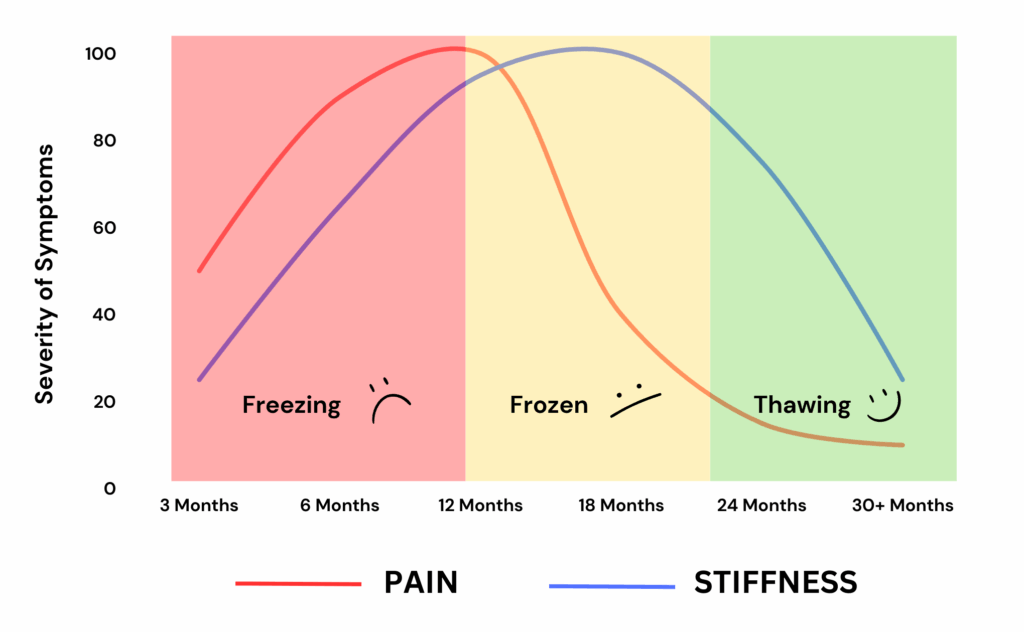
Frozen shoulder progresses through three commonly recognised stages:
- Freezing Stage – Pain is dominant, stiffness gradually increases
- Frozen Stage – Pain reduces, stiffness is the main limitation
- Thawing Stage – Movement slowly and steadily returns
These stages are not rigid; someone can have features of two stages at the same time or progress faster or slower than average. The entire process typically takes 12–36 months, but with correct management many people improve sooner.
Stage 1 — The Freezing Stage (Pain More Than Stiffness)

What This Stage Feels Like
- A deep, aching pain that may spread into the upper arm
- Sharp pain with certain movements
- Significant difficulty sleeping
- Shoulder gradually becoming stiffer
- Pain is the main driver of limitation
People often mistake this stage for a rotator cuff tear, impingement, or bursitis, which is why misdiagnosis is so common.
What’s Happening Inside the Shoulder
Inflammation of the joint capsule increases sensitivity and reduces tolerance to stretch. The capsule is starting to tighten, but pain still dominates.
How Long This Stage Lasts
Typically 6-12 months, but can be shorter or longer depending on severity.
Best Treatment in the Freezing Stage
- Pain relief first: Hands-on treatment, gentle mobilisation, ice or heat, medication (GP-guided)
- Avoid aggressive stretching — it usually makes symptoms worse
- Gentle mobility exercises only (pain-free range)
- Sleep position strategies to reduce night pain
- Corticosteroid injection may be considered (good evidence in early painful stage)
For a detailed guide on managing this phase, see the pain-dominant exercise program inside the Frozen Shoulder Treatment Guide (coming soon).
Stage 2 — The Frozen Stage (Stiffness More Than Pain)

What This Stage Feels Like
- Pain begins to ease, especially at rest
- Movement is very restricted
- The shoulder feels “blocked” or “stuck”
- Daily tasks like reaching overhead or behind your back are difficult
- End-range stretching feels tight rather than painful
What’s Happening Inside the Shoulder
The capsule has thickened and contracted, limiting movement in multiple directions. Pain tends to be limited to the end of range movements.
How Long This Stage Lasts
Commonly 6–12 months, depending on how early it was identified and treated.
Best Treatment in the Frozen Stage
- Progressive Mobility that targets capsular tightness
- Strengthening exercises to prevent muscle loss
- Hands-on mobilisation to restore movement
- Consistency is key — small, regular improvements add up
- Hydrodilatation (distension injection) may help some patients if progress plateaus
Stage 3 — The Thawing Stage (Improving Mobility)
What This Stage Feels Like
- Movement gradually improves
- Pain is minimal
- Strength and function return
- You can perform more day-to-day activities without discomfort
This stage often progresses slowly but steadily as the capsule naturally loosens.
What’s Happening Inside the Shoulder
The joint capsule remodels and regains flexibility, allowing more movement over time.
How Long This Stage Lasts
Typically 6–12 months, but significant improvement can occur sooner with targeted rehabilitation.
Best Treatment in the Thawing Stage
- More advanced stretching
- Strengthening and control exercises
- Functional training for reaching, lifting, sport, or work tasks
- Return-to-activity planning
This is where patients often see the biggest gains in confidence and function.
How to Tell Which Frozen Shoulder Stage You’re In
You may be in the Freezing Stage if:
- pain dominates over stiffness
- night pain is severe
- movement worsens rapidly
You may be in the Frozen Stage if:
- pain has started to settle
- severe stiffness is the main issue
- the shoulder feels mechanically blocked
You may be in the Thawing Stage if:
- movement is improving
- pain is mild or absent
- you can do more before symptoms increase
If you’re unsure, a physiotherapist assessment helps determine the stage and align treatment with where your shoulder is actually at.
What to Expect Over the Full Timeline
A realistic recovery timeline looks like this:
- Painful stage: 6-12 months
- Stiff stage: 6-12 months
- Thawing Stage: 6-12 months
Some people recover faster — especially when treated early and appropriately — and some progress more slowly.
When to Seek Professional Help
You should seek help if:
- your pain is worsening
- you’re unsure which stage you’re in
- stretching makes symptoms worse
- daily tasks are becoming increasingly difficult
- you’ve been misdiagnosed previously
- progress has stalled for more than 4–6 weeks
A correct diagnosis and a stage-matched management plan are the keys to recovering efficiently.
Your Next Steps

If you'd like structured, stage-specific exercises and a clear roadmap, our Frozen Shoulder Treatment Guide (coming soon) provides:
- tailored exercise programs for each stage
- sleep strategies
- injection information
- pain-relief methods
- recovery roadmap
- progress checklists
Alternatively, book an appointment with Perth Shoulder Physio